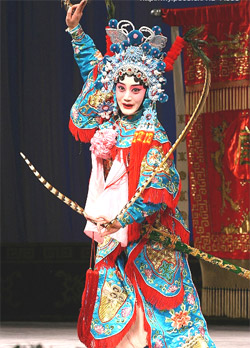
Beijing Opera of China is a national treasure with a history of 200 years. In the 55th year of the reign of Emperor Qianlong of the Qing Dynasty (1790) , the four big Huiban opera Troupes entered the capital and combined with Kunqu opera, Yiyang opera, Hanju opera and Luantan in Beijing's theoretical circle of the time. Over a period of more than half a century of combination and integration of various kinds of opera there evolved the present Beijing Opera. Beijing Opera is the most significant of all operas in China, and it has a richness of repertoire, great number of artists and audiences, that give it a profound influence in China and plays a large role in Chinese culture.

The repertoire of Beijing Opera is mainly engaged in fairy tales of preceding dynasties, important historical events, emperors, ministers and generals, geniuses and great beauties, from the ancient times to Yao, Shun, Yu, the Spring and Autumn Period, the Warring States Period and the dynasties of Qin, Han, Sui, Tang, Song, Yuan, Ming, Qing. Some of them also were adopted from the literature and classical novels, which are well known among the public but may not be an accurate account of history.
The types of facial make-ups in Beijing Opera are rich and various, depicting different characters and remarkable images, therefore they are highly appreciated. Moreover there are numerous fixed editions of facial make-up.
Since Mei Lanfang, the grand master of Beijing Opera, visited Japan in 1919, Beijing Opera has become more and more popular with people all over the world, and it has made an excellent contribution to cultural exchange between China and the West, to friendly association and to improvement of solidarity.

没有评论:
发表评论