2011年5月30日星期一

Researching

The style of this motion graphic is based on a kind of shadow-play (also called shadow puppetry), it is an ancient form of storytelling and entertainment using opaque, often articulated figures in front of an illuminated backdrop to create the illusion of moving images.


Because the technique is immature in ancient time, the lights keep flickering makes, that it makes the style I want to use on the motion graphic. And the background of the motion graphic is a kind of textured paper, that is in order to presents the atmosphere of ancient china.


The moving image inspired by Korean folk paintings, the artist create the work that integrates digital technology with tradition art. Moving images are installed in a folding screen-like frame. The work focuses on the expressive depiction of nature, in particular lotus flower and animals. The objects in movement create an illusion as if the artwork is alive in cyberspace.


2011年5月24日星期二

For Project 3: Exhibition Design

Introduction

I am going to create a motion graphic for the exhibition design, and projected it onto the wall in a small room, the purpose of this project is going to present the facial expression which formed by a set of vector drawings.


Basic Structure

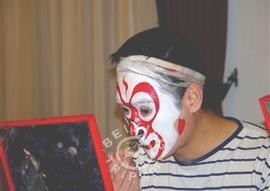
The structure of the huge face was based on the facial makeup of the Beijing Opera, and the small parts of the face comprise a mix of anything in the world, that is in order to present the combination of ancient and modern to the audience.


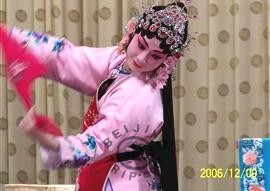
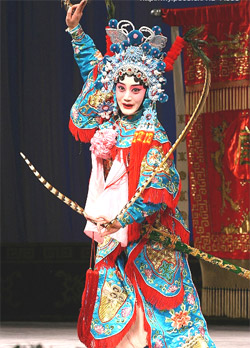
The inspiration and style of the facial expressions come from Beijing opera; it is a form of traditional Chinese theater which combines music, vocal performance, mime, dance and acrobatics. And by the characters in the opera, their stage costumes, and their eccentric patterns of Beijing opera masks (facial makeup), which are certainly exaggeration of the true lineaments. I am very interested in this, because its unique style, for example like, its music is mysterious and grotesque, the makeup in it is almost an art in itself, and its unique music; this is what I need to make the conception original and special.


How does that works
I will place 2-3 projectors in the studio, then the audience walks into there and seeing the motion graphic which has several huge faces appear on the screen.


2011年5月19日星期四

Beijing Opera


Beijing Opera of China is a national treasure with a history of 200 years. In the 55th year of the reign of Emperor Qianlong of the Qing Dynasty (1790) , the four big Huiban opera Troupes entered the capital and combined with Kunqu opera, Yiyang opera, Hanju opera and Luantan in Beijing's theoretical circle of the time. Over a period of more than half a century of combination and integration of various kinds of opera there evolved the present Beijing Opera. Beijing Opera is the most significant of all operas in China, and it has a richness of repertoire, great number of artists and audiences, that give it a profound influence in China and plays a large role in Chinese culture.

Beijing Opera is a synthesis of stylized action, singing, dialogue and mime, acrobatic fighting and dancing to represent a story or depict different characters and their feelings of gladness, anger, sorrow, happiness, surprise, fear and sadness. The characters may be loyal or treacherous, beautiful or ugly, good or bad, their images being vividly manifested.
The repertoire of Beijing Opera is mainly engaged in fairy tales of preceding dynasties, important historical events, emperors, ministers and generals, geniuses and great beauties, from the ancient times to Yao, Shun, Yu, the Spring and Autumn Period, the Warring States Period and the dynasties of Qin, Han, Sui, Tang, Song, Yuan, Ming, Qing. Some of them also were adopted from the literature and classical novels, which are well known among the public but may not be an accurate account of history.


The types of facial make-ups in Beijing Opera are rich and various, depicting different characters and remarkable images, therefore they are highly appreciated. Moreover there are numerous fixed editions of facial make-up.
Since Mei Lanfang, the grand master of Beijing Opera, visited Japan in 1919, Beijing Opera has become more and more popular with people all over the world, and it has made an excellent contribution to cultural exchange between China and the West, to friendly association and to improvement of solidarity.

2011年5月12日星期四

EXHIBITION DESIGN_MOVING IMAGE

Concept_1: Beijing Opera
For the project 3, I am going to create a moving image piece for final exhibition design. I’ve got following 3 concepts for moving image design.


The audience may place his head into the installed position and seeing a huge face appears on the screen.


the inspiration and style of the facial expressions come from Beijing Opera.


The sound effect plays the selected tunes of Beijing Opera( Jingju ).

Concept_2: Abstract of light
I am going to create a kind of stop motion animation that uses a combination of light with stencils and long exposure photography to tell the story of all around the city at night.


If life is catwalk, run like a dog. I am trying to present a kind of life style at night, the drunks, the clubs, stray dogs and so on.


And I want the animation to have a dream like quality exploring the reality and space at night.

Concept_3:Optical Illusion


An optical illusion ( also called a visual illusion) is characterized by visually perceived images that differ from.


I am trying to make a bit of an experiment, to make a ‘weave’ (literally rods/tubes woven in and out of each other), add some animation and have a rather cool ‘optical illusion’ type effect.

Sound Effect
The music and sound effect of this animation is rhythmical, and graphic changes by the sound effect and music.

Reference:
http://vimeo.com/18289150
http://vimeo.com/22912569
http://vimeo.com/20230217
http://en.wikipedia.org/wiki/Peking_opera
http://www.michaelbach.de/ot/
http://www.youtube.com/watch?v=QZerH2Ac9tg

2011年5月3日星期二

EXHIBITION DESIGN


Julia Yu Tsao


Graduate Thesis Project, Fall 2009


Media Design Program, Art Center College of Design


Animatied in Maya


Curious Displays functions simultaneously as a form of design research and as a proposal for a new product, a future display technology.


desginer's description: The project explores our relationship with devices and technology by examining the multi-dimensionality of communication and the complexity of social behavior and interaction. In its essence, the project functions as a piece of design fiction, considering the fluctuating nature of our present engagement with media technology and providing futurist imaginings of other ways of being.


The interactive audio-visual installation 'Lightrails' was a project that Strukt created together with unheilbar architektur for sound:frame Festival taking place at the Project Space inside the Kunsthalle Wien.

'Lightrails' is a light sculpture with the intention to re-define and re-interpret the exhibition room. An easy but effective mapping technique was used to create seamless projections on both sides of the object. Light-beams were triggered by the visitors and ran through the room, following the surface created by the sculpture. Each "reflection" of the light-beam was accompanied by sound. The speed and brightness of the beam was directly influenced by the force the visitors used when triggering the beam stepping on pedals on the floor. This also influenced the volume of the sound-effects. The audio signal was played back on a surround sound system that allowed a spatial positioning of the sounds and created a truly immersive experience.ounds to create a truly immersive experience.